By Mavuso Msimang
Last year, the South African government spent an estimated R500 million deporting 109,344 undocumented African migrants. Do the arithmetic, as one occasionally must in this line of work, and the figure comes to roughly R2,670 for every person removed: the diesel for the buses, the wages of the officials, the paperwork that will be filed and, in time, forgotten. It is an impressive machine, in its way. Planes were chartered. Police were deployed. Detention centres, those grim way-stations of our national conscience, were filled and emptied and filled again. The exercise made headlines, as such exercises reliably do. It made no discernible difference whatsoever.
Because this month, more people crossed. Not for the thrill of it, one hastens to add, and certainly not because the Limpopo River offers a superior aesthetic experience to the N1. They crossed because there is no power to run a welding machine in Bulawayo, no irrigation to plant maize in rural Malawi, and no factory work to be found in Beira. We are, in short, attempting to police our way out of a development problem. It is expensive. It is inhumane. And it does not work, has not worked, and will not work, however many billions we throw at the border in the vain hope that a fence might succeed where a fair economy has failed.
It is worth pausing on that R500 million a moment longer, if only because our public discourse rarely does. It is roughly the annual budget of several rural district hospitals, or the cost of refurbishing a few hundred kilometres of the provincial roads that our motorists curse daily and our engineers repair rarely, if at all. Spent on removal, that money vanishes into an administrative churn that produces no asset, teaches no skill, and answers no question except the one nobody was seriously asking, namely whether the state can move people. Of course it can. The apartheid state was, if nothing else, extraordinarily competent at moving people against their will. That we have inherited the machinery and merely redirected its target ought to trouble our public representatives far more than it evidently does.
There is, however, another way. It begins with the acceptance of one uncomfortable truth, the kind that tends to be more palatable in a seminar room than at a ballot box: no country in the Southern African Development Community can prosper alone. Sic transit the fantasy of splendid isolation. We are, whether or not we admit it in polite Tshwane company, bound to our neighbours by geography, by history, and by the plain economic logic that a customer without a job cannot buy what we are selling. Need we be reminded that since at least the discovery of gold, Southern Africa has been a single labour market. Tens of 1000s of nationals from Lesotho, Mozambique, Malawi, etc. worked on the mines but were locked away in the compounds so that South Africans – black and white – removed them from their minds. To expect this century and a half practice of SA being the core of a single regional labour market to be stopped by a border fence is crazy.
First, let us kill the myth
The loudest narrative in our politics, repeated with the confidence of received wisdom and about as much scrutiny, holds that migrants “steal jobs”. It is a tidy story. It is also, on the evidence, false. Multiple studies from Wits, the University of Cape Town, and the Small Enterprise Development Agency, have found that migrant entrepreneurs are, on balance, net job creators rather than job destroyers. For every SADC national – or Pakistani for that matter – who opens a spaza shop, a panel-beating workshop, or a construction crew on South African soil, an average of two South Africans find employment in consequence.
These same migrants are also taxpayers and consumers, a fact that our politics prefers not to dwell upon. They rent houses, buy data, and pay VAT on every loaf of bread and every litre of fuel, quietly and without complaint, in a manner that would put certain of our better-remunerated middle class to shame. When we raid and deport, we do not simply remove a worker from the informal economy. We remove a customer and an employer in the same stroke, and we congratulate ourselves on the achievement.
Driving people underground with fear does not create jobs; it creates an informal economy in which no one pays tax, no one is protected, and wages are driven down for everyone, citizen and foreigner alike. The genuine pressure on South African employment is not the spaza shop on the corner. It is load shedding. It is anaemic growth. It is a region that has, for three decades of democratic promise, failed to develop as a region.
The SADC Marshall Plan: three catalytic projects
If we wish to see fewer people at our border, we must create more opportunity at theirs. That requires thinking like a region of sixteen countries, not sixteen separate fiefdoms each guarding its own patch. What follows is not a utopian sketch but a set of three catalytic projects capable, on a ten-year horizon, of transforming SADC’s economic geography.
The first concerns power, and it begins with ring-fencing the INGA Dam. The Democratic Republic of Congo’s INGA scheme on the Congo River has the potential to generate 40,000 megawatts, more than double Africa’s current hydro-electric capacity, a statistic so large that it borders on the unbelievable until one recalls the sheer volume of water the Congo moves to the Atlantic each second. Phase 1 alone will cost in the region of $14 billion. The proposal is straightforward in outline, if formidable in execution: SADC takes a 99-year lease, pays the DRC a guaranteed $1 billion annually, and establishes a regional power pool through which electricity is sold across the bloc. This should be complemented by Mozambique’s substantial gas reserves, deployed for fertiliser production and baseload power generation. First power from Phase 1 could reasonably be expected by 2030.
The second concerns food, and it involves making Zambia the SADC Agricultural Research Centre. Zambia is water-rich, land-abundant, and centrally located, possessed of every natural endowment required to become the region’s breadbasket save the institutional architecture to realise it. The proposal: invest $3.5 billion over ten years to establish a SADC Agricultural Research Centre on Zambian soil, with a mandate to develop drought-resistant seed varieties for the region, to run a regional seed bank, to produce fertiliser using Mozambican gas, to train 500,000 smallholder farmers annually, and to operate a SADC food security early-warning system. Begun in 2027, such a centre could be fully operational within five years.
The third concerns trade, and it requires building regional ports and corridors. Landlocked countries cannot grow without access to the sea, a truth so self-evident that it requires no citation, only observation of a map. The proposal: invest $31 billion to expand the ports of Maputo, Beira, Nacala, and Walvis Bay, and to build the rail and road corridors linking Zambia, Zimbabwe, Malawi, Botswana, and the DRC to the coast. Special Economic Zones would follow along an elegantly simple principle: grow in Zambia, process in Mozambique, export to the world. A programme of this scale would reasonably require six to eight years.
The total catalytic investment across all three projects comes to somewhere between $60 billion and $120 billion over a decade. It sounds like a great deal of money, and it is. But the cost of inaction is higher still: lost GDP, chronic instability, and the billions we already waste, year upon year, on a border that will never be “secure” while our neighbours remain poor. Cheaper, in other words, to build the region than to fence it.
Owned by all sixteen, not merely three
This plan cannot belong to the DRC, Zambia, and Mozambique alone, however central their geography makes them to its execution. Zimbabwe’s engineers and steel would help build INGA. Botswana’s water scientists, among the finest on the continent, would help run irrigation schemes in Zambia. Namibia’s Walvis Bay and Tanzania’s Dar es Salaam would form part of the port network. Malawi’s farmers would receive the first drought-resistant seeds to leave the research centre’s gates. Lesotho and Eswatini would gain from the manufacturing that regional power and transport make possible.
Every SADC state has a role, a vote, and a benefit in this arrangement. It is a SADC project, governed by SADC. It is not a charity project, and it should not be mistaken for one; it is a partnership, in the fullest and least sentimental sense of that word.
The front door, not the bush
With jobs and power available in every country, migration becomes an orderly affair rather than a nightly gamble with the river and the fence. SADC must implement a biometric regional work permit system, structured around sector-based quotas, so that movement across borders is a matter of process rather than peril.
Consider the builder from Lesotho, who applies in Maseru, is cleared within 48 hours, works nine months in Gauteng, pays his tax and his UIF, and returns home when the contract ends. Consider the farm worker from Zimbabwe who comes for the citrus season legally, harvests the crop, and departs with dignity intact. This is not a fantasy; it is administration, the dullest and most necessary of the state’s arts.
Here, then, is the policy choice, reduced to a single sentence: we can spend billions chasing people through the bush, or we can spend billions building a region, and invite them through the front door with a work permit in hand.
Why SADC wins, and why South Africa must lead
Regional integration fails whenever a single country attempts to benefit alone; this is not an opinion but a lesson written into the economic history of every failed customs union since World War 2. Three arguments recommend the alternative.
First, industrialisation would spread across the region. Cheap power and efficient transport mean factories can be located in Bulawayo, Gaborone, or Dar es Salaam, and not exclusively in Gauteng, which currently bears a disproportionate share of the region’s industrial ambition and an even greater share of its congestion.
Second, resilience would become shared rather than solitary. A regional power and food system means that when Malawi suffers a drought, Zambia can help; when South Africa suffers load shedding, INGA can help. No single country need face its worst year alone.
Third, South Africa’s role is that of an anchor, not a benefactor. As the region’s largest economy and financial centre, South Africa must help anchor this project. Our banks, our logistics networks, and our skills base can help unlock the necessary investment. In return, we gain a larger market and, at long last, stable borders. That is leadership, properly understood, and not dominance dressed up in its language.
None of this absolves the region’s governments of their obligations to their own citizens, and it would be dishonest to pretend otherwise. A plan of this ambition will only survive contact with reality if it is administered with a rigour our public institutions have not always shown. Every dollar of that $60 billion to $120 billion must be tracked, audited, and answered for in a manner our procurement processes have too often failed to guarantee. Officials who treat regional development finance as a private tollgate should face the same consequences as those who loot a municipal coffer, and the citizens of Lusaka and Lilongwe deserve exactly the accountability that the citizens of Johannesburg and Cape Town demand of their own councils. A Marshall Plan built on graft is not a Marshall Plan; it is merely corruption at a grander scale, dressed in the language of solidarity. Fairness, after all, cuts in every direction, or it is not fairness at all.
A prosperous SADC of 350 million people could trade with the world as equals rather than supplicants. The European Union offers the obvious, and rather instructive, precedent. After 1945, France and Germany ceased fighting one another and began instead to trade coal and steel, a modest beginning to what became the most successful peace project of the modern era. Today a Pole works legally in Berlin, and a German retires, unremarkably, in Spain. Nobody regards either arrangement as extraordinary any longer. That, too, is the measure of success: when yesterday’s impossibility becomes tomorrow’s Tuesday.
We can do the same. The border will be secure on the day a young man in Harare has light in his home, a job to go to in the morning, and food on his table at night. Not before.
It is time, at last, to choose development over deportation. We rise together, or, as history has shown often enough to those who did not wish to learn the lesson, we fall together.
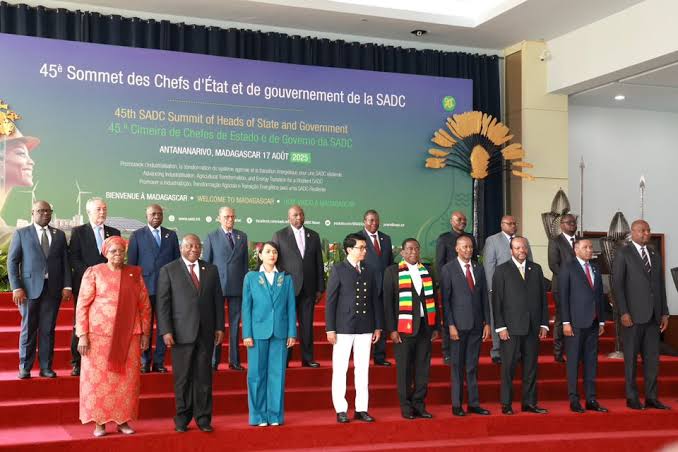
The SADC Summit of heads of State and Government meets in Durban on 16-17 August, 2026.