By Zubeida Jaffer
Words matter. Especially when they come from the deep quiet within our souls.
In 1998, UWC’s Diana Ferrus was studying at University of Utrecht in The Netherlands. The story of the ordeal of Sarah Baartman plucked from our country in 1810 and paraded in European ‘freak shows” left her drenched in tears. She was homesick. At the time she also was aware of French reluctance to release Baartman’s remains from the Musé de L’Homme for repatriation.
Through her tears it was as if she heard Sarah’s voice call, “I want to go home, I want to go home.” She turned around and went to her desk and penned the poem “I’ve come to take you home”. (Listen to her recite the poem here.)
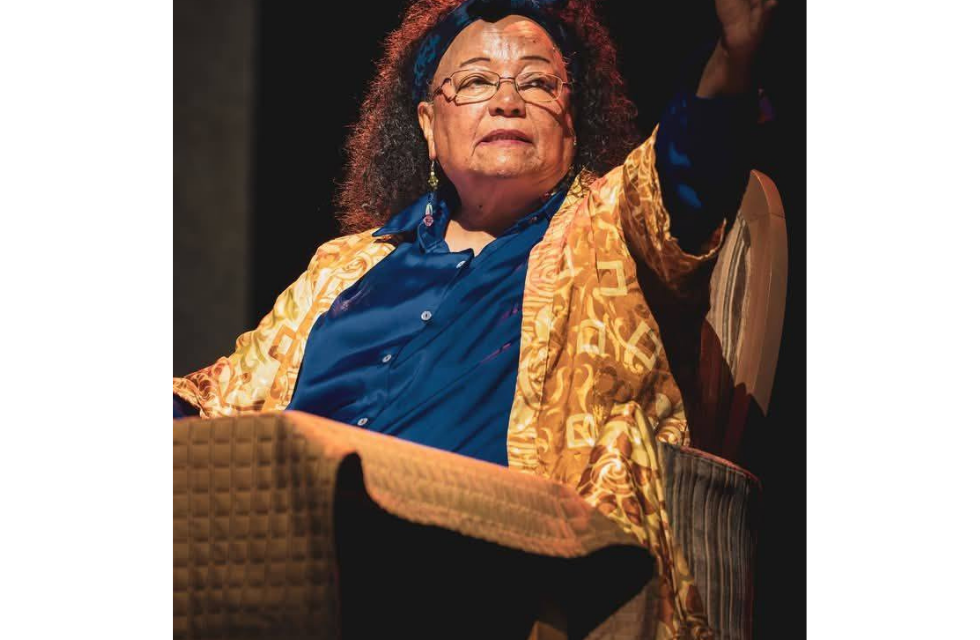
Diana Ferrus died a few days ago on 30 January 2026. She closed her eyes after a short illness. How glorious that she lived to experience the impact of her poem on our country, the French parliament and beyond.
In 2002, four years after writing the poem, it enabled the return of Sarah Baartman’s remains – a first in French history. She arrived home 192 years after her departure and was buried on 9 August that year in Hankey, Gamtoosvalley in the Eastern Cape, the valley where she came from.
What happened in those four years after she heard Sarah’s call? Events unfolded like she could never have imagined. She returned home, read the poem deeply moving local audiences.
The treatment of this one woman was emblematic of the European colonial humiliation imposed on all at the southernmost tip of Africa and across the world.
In her own words DianaFerrus described how Sarah Baartman, was taken to England in 1810 under false pretenses. At an academic conference she told the story as follows:
Upon arrival William Dunlop, her owner immediately put up advertisements on lamp posts and in newspapers, “New, new from South Africa, the Hottentot Venus, come and buy your tickets, come and see.” This was to be the start of a journey of exploitation, humiliation, of pain.
She ended up in Paris where Dunlop sold her to Reaux, an animal trainer. Reaux
in turn used her in freak shows and exhibited her. The scientists Georges Cuvier and
Geoffrey St Hillaire wanted her to pose in the nude so that they could inspect her
private parts. Up to her death she refused to. The harsh treatment in Paris and forced
prostitution led to her early death, at the end of 1815 she died at the age of 25.
It was then that Cuvier made a plaster cast of her body, put her brain and genitalia
in formalin and dissected the body. He held numerous talks and wrote books in which
he declared that of all the races that he studied, Sarah’s was the closest to the mon-
key. She had lips like an orangutang, and woolly hair, in fact, she was what Darwin
would call “the missing link between human and ape”. Her remains were then put on
display in the Musee de l’Homme in Paris from 1816.
In South Africa, the Griqua people, a tribe of the Khoekhoe petitioned the French as
early as the 1950s to send her remains home. The remains should be buried in order
for the soul to rest, they believed. The French would not budge because they made a
law in 1850 that all artifacts in French museums belonged to the French state
Then a French Senator Nicholas About came across the poem on the internet. He wrote to Diana saying that the poem showed exactly how Sarah’s people felt about her remains still being in Paris. He was extremely moved by the poem and wanted to use it as part of his argument/bill to have Sarah’s remains returned to South Africa. It was a like a dream come true for her.
Senator About had the poem translated into French and read it as part of his bill in the French Senate on 29 January 2002. The poem today stands as part of the law that enabled the return of Sarah Baartman’s remains.
Yes, dear Diana. Your words mattered. They moved mountains. May your soul rest in peace.
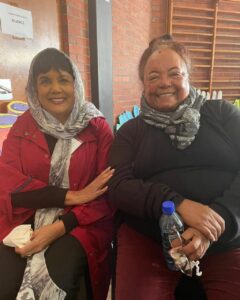
Diana Ferrus with Zubeida Jaffer at the launch of the new library at Modderdam High School in April 2023.