By Len Kalane
Part One: The Economics Before the Emotion
Before the singing started, before the green and gold swallowed Soweto whole, there was a number worth sitting with: this was only the fourth time in history the Springboks had played a Test at FNB Stadium, and the first since 2013.
In a rugby calendar dominated by Loftus Versfeld in Pretoria, Ellis Park in Johannesburg’s north eastern suburbs, and Newlands and its successor in Cape Town — grounds built, in another era, for a game that belonged almost exclusively to white South Africa — a Springbok Test in Soweto is still, remarkably, an event rather than a routine.
That rarity is not an accident of scheduling. It is a legacy of where rugby’s money, infrastructure and traditional fan base have always sat. The old “home” grounds are close to affluent, historically white suburbs, easy to reach by car, ringed by corporate hospitality and season-ticket culture.
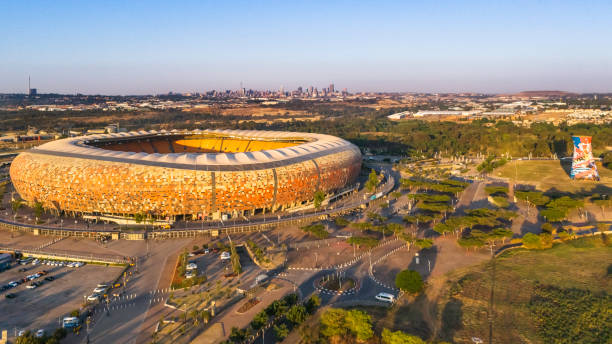
Soweto is twenty-odd kilometres and, for many of its residents, a very different tax bracket away from that world. So when the Rugby’s Greatest Rivalry organisers chose FNB Stadium — Soweto’s own Calabash, scene of the 1996 Africa Cup of Nations final and the 2010 World Cup final — for the third Test against New Zealand, they were making a statement with the fixture list as much as with the team sheet.
The financial case was straightforward: a near-90,000-seat stadium, the biggest in the country, filled to a record for the fixture. Reports put the crowd at 85,967, more than the traditional rugby grounds could ever hold, a boost for broadcasters, sponsors and the local economy of taxis, traders and stallholders around the stadium precinct on match day. The social case was more complicated, and it is the one that generated the emotion: rugby’s economic centre of gravity moved for one night into a community that has historically supplied the labour, the noise and the loyalty for South African sport, without always sharing in the seats.
Because for all the goodwill of playing in Soweto, the tickets were still priced for a national and international market, not a township wage. That contradiction — a Test match “for the people” that most of the people around the stadium could not afford to attend — sat underneath everything that followed on Saturday night, including the parts that made grown men cry.
Part Two: Colour From the Ground
By kick-off, FNB Stadium’s rim of gold roofing was doing what it always does under floodlights — turning the whole bowl into something that looks, from outside, like a second sunset. Inside, the noise built the way it always does in Soweto: not a slow murmur but a wall, sustained, so that by the time the anthems played there was very little air left in the stadium that hadn’t already been shouted into song.
The crowd itself was the story that photographers kept returning to. Bomber jackets and vuvuzelas next to replica jerseys that cost more than a week’s wages for some of the people wearing them; church groups from the township mixed with corporate boxes flown in from Sandton; a sea that was green and gold but also, unmistakably, black, brown and white together, in ratios that a Springbok Test at Loftus or Newlands rarely produces. Local radio and township FM stations ran build-up all week, taxi ranks did brisk business, and shebeens and sports bars along the routes into the stadium filled early with fans who never intended to get anywhere near a ticket gate.
The match itself supplied its own theatre — a tight, error-strewn arm-wrestle at 12-12 by half-time before the Springboks pulled clear in the second half to win 29-24, their first ever victory over New Zealand at that ground after defeats there in 2010 and 2012. When Malcolm Marx powered over from a driving maul to break what commentators called the “Soweto curse,” the stadium’s noise changed register entirely, and terrace chants of the coach’s name rode the tannoy music out of the ground.
But the image that outlasted the scoreline came from outside the stadium walls, before a ball was even kicked. Springbok captain Siya Kolisi and coach Rassie Erasmus both described, independently and in near-identical terms, the same moment on the drive in: children sprinting alongside the team bus through the streets of Soweto, waving, chasing, trying to catch a glimpse of players they had grown up idolising on television — knowing, as they ran, that they would not be inside later that night.
I was unbelievably emotional today because I wanted us to come to Soweto and take it to the people, and then I thought, ‘they don’t have the money to come into the stadium.’
Kolisi picked up the same thread afterwards, visibly moved, framing the win as a debt paid to people who could only watch the bus go by. He spoke of playing not only for those who could afford tickets but for every South African, and of understanding, standing in Soweto, the history that had to happen before he could be the one leading the team through it.
Part Three: The Race Subtext Nobody Can Avoid
In a country as marked by its racial history as South Africa, a mixed, roaring crowd in Soweto watching the old “white man’s game” was never going to be read simply as a rugby result. Within hours, the same footage that had players in tears was being read in opposite directions on WhatsApp groups across the country — and both readings are worth setting down, because both capture something true about how South Africans experience these moments.
The optimist's reading
The support that SA showered on the Springboks against the All Blacks demonstrated the non-racialism that the people desire for their beloved country. At the stadium the tens of thousands of supporters of all colours joined together to urge the Springboks to victory. The cohesion among the supporters is a clear message that we are one nation, working and joining together for a non-racial, democratic SA.
WhatsApp group post, shared after the match
This reading has history on its side. It echoes 1995, when Nelson Mandela wore Francois Pienaar’s number six jersey and a divided country found, for one afternoon, something to share. It echoes 2019 and 2023, when Kolisi — the first black Springbok captain — lifted the World Cup twice and townships and northern suburbs alike shut down to watch. For many South Africans, a full, mixed stadium in Soweto is exactly the kind of evidence they want: proof that the country the Constitution promised is being built, one shared roar at a time.
There was a counter view…
Whites benefit the most out of our new non-racialism than the blacks. Blacks fill the stadium to watch the Springboks – how many whites do you see at a Bafana game?
WhatsApp group post, shared after the match
This reading has its own evidence. It notes that the traffic of goodwill mostly runs one way: black South Africans turn out in huge numbers for a team that, for ninety years, excluded them by law and custom, while the historically white sporting establishment rarely reciprocates by filling stands for football, the sport overwhelmingly followed and played in black communities. On this account, “non-racialism” in South African sport looks suspiciously like black South Africans doing most of the emotional and physical work of reconciliation, while the benefits of a unified, marketable Springbok brand — sponsorship, tourism, feel-good nation-branding — accrue disproportionately to interests that were never asked to change very much.
Neither view is simply wrong. A stadium can be genuinely mixed and joyfully so, and the underlying economics of who can afford to be there, and who chooses to reciprocate the support at other codes, can still run along old lines. Soweto on Saturday night was both things at once: real, cross-racial delight, sitting on top of a support relationship that remains, on the numbers, lopsided.
Part Four: Why Doesn't the Reverse Happen? Bafana and the Missing Crowd
The Bafana view deserves a straight look, because it is checkable in a way that arguments about “the vibe” usually aren’t: how many white South Africans turn out for Bafana Bafana, the men’s national football team, at anything like the rate black South Africans turn out for the Springboks?
The honest answer is: not many, and increasingly, not many South Africans of any race. Bafana Bafana’s home fixtures in recent years have repeatedly drawn stands so sparse that pictures of them have become their own minor news story — friendlies against Namibia and the Republic of Congo played to what reporters described as virtually empty terraces, even in Soweto itself, the team’s own backyard. The crowds came in numbers during the Hugo Broos era after a series of wins otherwise coverage of South African football has noted the prior decline as a broad, cross-racial problem: soccer remains statistically the country’s most-played and most-watched sport on television, yet the national team specifically has struggled to fill stadiums even against modest opposition, a pattern commentators link to years of underachievement, a chaotic domestic administration, and low expectations rather than to any single community staying away on principle.
Two things seem to be true simultaneously. First, there is a genuine racial asymmetry in which national teams different communities were raised to treat as “theirs”: rugby and cricket carry deep historical roots in white, and especially Afrikaans, community life, while football’s grassroots base has always been overwhelmingly black and township-centred — yet post-apartheid black South Africans embraced the Springboks (and the Proteas) far more enthusiastically than white South Africans have embraced Bafana, partly because Springbok success since 1995 gave a unifying, winning story to buy into, and partly because reconciliation politics — from Mandela’s jersey onward — was explicitly built around rugby, not football. Second, Bafana’s specific attendance problem looks less like racial boycott and more like a team whose form, ranking and off-field administration have exhausted patience across the board; low crowds at Bafana games are now a talking point among black South African commentators and fans just as much as a symptom cited by rugby-focused critics. The Broos era has injected renewed enthusiasm and Bafana new coach Pitso Mosimane is expected to take the numbers further up but he can’t be alone in this – the South African Football Association (Safa) has to come to the party at much the same level as the South African Rugby Union(SARU) does – games are won both on the pitch and the boardroom.
Suffice to say it is not so much that white South Africans are deliberately withholding support from a black-coded sport, as that South African sport still lacks a football equivalent of 1995 or 2019 — a result, a captain, a story dramatic enough to pull casual fans of every background off the couch and into the stands the way the Springboks now reliably do. Until Bafana produces one, the comparison being drawn on WhatsApp groups will keep writing itself, match after sparsely attended match.
Closing Frame
Soweto got its Springbok Test back after thirteen years, filled a stadium built for exactly this kind of night, and watched a coach and a captain be undone, on camera, by the sight of children who would never get inside. That is not spin; several thousand match reports and player interviews agree on it. What it means for “non-racialism” in South Africa depends, as it always has, on which parts of the picture you choose to hold in focus — the roar inside the stadium, or the children running alongside the bus outside it. The most honest colour piece may be the one that refuses to resolve that tension, and simply reports both.
LEN KALANE is former City Press newspaper editor, author of The Chapter We Wrote – The City Press Story and now founder and publisher of publisher of PiE Digital Platform, a brand new initiative to create a commercial site designed by an all-South African and African cast. This story first appeared at www.piedigital.Africa.
Editor’s note: I publish two articles on the glorious rugby game in Soweto on Saturday 5 September, 2026. I do so to mark a moment that once again affirms the vision of a united South Africa that beats in South African hearts. Read with thought and enjoy the moment in words.