By Taz Cassim
There are moments in sport when a player becomes something larger than the game. On Saturday night in Soweto, in front of 85,967 people at FNB Stadium, Siya Kolisi did not simply lead the Springboks to another victory over the All Blacks. He reminded South Africa why he became captain in the first place.
The Springboks beat New Zealand 29-24, coming from behind in a ferocious third Test to take an unassailable 2-1 lead in the four-match series. The final Test will be played in Baltimore next weekend, but the All Blacks can no longer win the series.
Somehow the setting felt as important as the result. Soweto carries some of the deepest memories of South Africa’s struggle for freedom. Rugby was never historically the dominant sporting language there.
That is where Siya Kolisi, the boy from Zwide, walked out as captain of the Springboks and led South Africa against New Zealand. That is not simply a sporting story. It is a South African story.
A week earlier in Cape Town, Kolisi had returned to the Springbok starting XV after injury and helped South Africa recover from the humiliation of the 33-16 defeat to New Zealand at Ellis Park. The Boks responded with a 33-26 victory.
Soweto was different. Cape Town had witnessed the return of a captain. Soweto witnessed something closer to a coronation.
The All Blacks started brilliantly. Ardie Savea scored twice in the first half and New Zealand looked capable of taking control of the match. South Africa fought back.
Kurt-Lee Arendse scored. A penalty try brought the Boks level at half-time. Then came the second half.
Jesse Kriel broke through. Malcolm Marx powered over from a rolling maul. Sacha Feinberg-Mngomezulu kept the scoreboard moving.
The All Blacks fought to the end. South Africa held on. The score was 29-24.
Back-to-back victories over New Zealand. Siya Kolisi had now become the most successful Springbok captain in terms of Test victories, with 55 wins as captain. The numbers do not explain why the moment felt so significant.
For that, we have to go back.
To understand Siya Kolisi, we have to understand Nelson Mandela. In 1995, Mandela understood that sport could accomplish something politics alone could not.
The Rugby World Cup was being played in South Africa. The Springboks remained deeply associated with white South Africa and with the history of apartheid.
Mandela could have rejected the symbol. Instead, he embraced it. When he walked onto the field wearing Francois Pienaar’s number six Springbok jersey, he did something extraordinarily courageous.
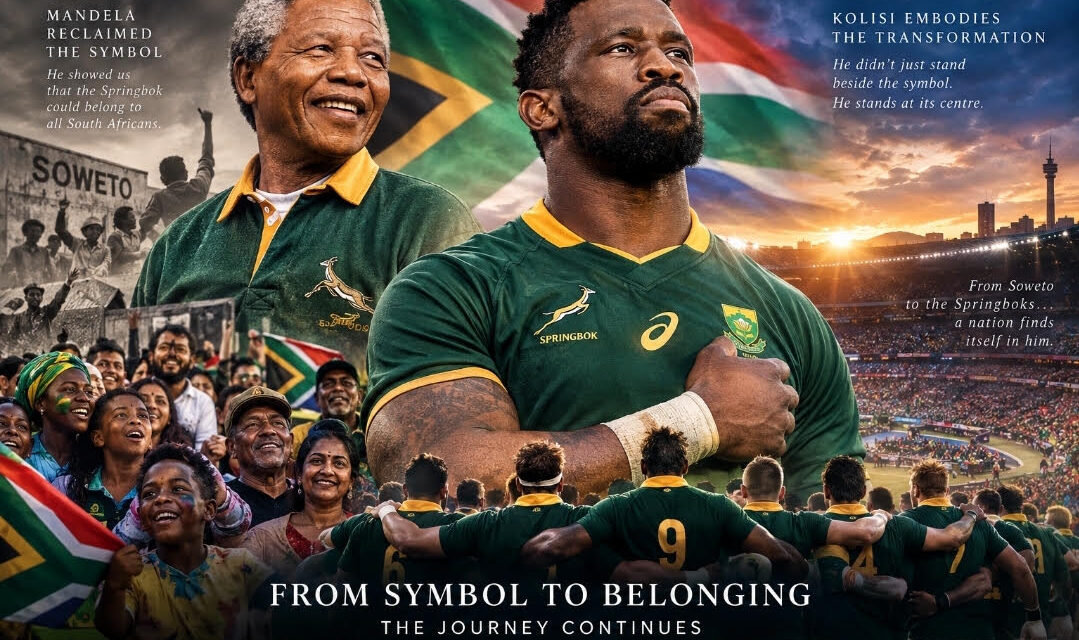
A proud Black South African chose to embrace an emblem that many Black South Africans had been taught to regard with suspicion, hostility or indifference. Mandela understood the power of symbolism. He was not surrendering to the old South Africa. He was reclaiming the symbol for the new one.
That day, wearing the jersey of a white Springbok captain, Mandela offered a vision of reconciliation. He was telling the country that the symbols of the past did not have to remain prisoners of the past.
Thirty-one years later, there is something profoundly moving about watching a proud Black South African stand in that same jersey as captain of the Springboks. Siya Kolisi is not merely wearing the symbol. He embodies its transformation.
There is an important distinction between Mandela’s moment and Kolisi’s. Mandela stood beside the Springbok symbol and helped a divided country embrace it. Kolisi grew up in the new South Africa and became one of the men who transformed what that symbol could mean.
That transformation is not complete. It would be dishonest to pretend that rugby has somehow transcended South Africa’s inequalities. Many Black South Africans remain alienated from the sport. Transformation within South African rugby remains unfinished and contested.
Kolisi does not erase those realities. He represents something extraordinary within them. A child from Zwide, who grew up with very little, became the captain who lifted the Rugby World Cup. Then he lifted it again.
Now he stands before almost 86,000 people in Soweto wearing the Springbok jersey and leading South Africa against the All Blacks. The symbolism is almost too perfect.
There are extraordinary players in this Springbok team. Pieter-Steph du Toit can dominate a match. Eben Etzebeth can intimidate an opponent. Malcolm Marx can change a game through sheer physical force.
Jesse Kriel can produce moments of brilliance. Sacha Feinberg-Mngomezulu is beginning to look like a player capable of carrying the Springboks into the future. None of that diminishes what they bring to South Africa.
Siya brings something different. He galvanises. He has an extraordinary ability to alter the emotional temperature of a stadium.
When he sings the anthem, the crowd sings with him. When he walks onto the field, something changes. When the team is under pressure, his presence seems to communicate that South Africa will not surrender.
That is a rare sporting gift. It cannot be measured simply in metres carried, tackles made or tries scored. It is leadership as emotional infrastructure. His influence seems disproportionate to his statistics.
Before the match, Kolisi spoke about the significance of playing in Soweto and the inspiration that could come from the history of the place. The Springboks were not simply playing another Test match. They were playing in a part of South Africa whose history is inseparable from the struggle against apartheid.
That is what makes the image so powerful. In 1976, Soweto became synonymous with a generation of young Black South Africans challenging an oppressive state. In 1995, Nelson Mandela walked onto a rugby field wearing the jersey of a sport historically associated with white South Africa. In 2026, Siya Kolisi walked onto a rugby field in Soweto as captain of the Springboks.
The journey between those moments is the story of South Africa itself. It is not a perfect journey. It is not a completed journey. It is a remarkable one.
Mandela wore the Springbok jersey because he understood that reconciliation sometimes requires us to embrace what once divided us. Kolisi wears the Springbok jersey because, for millions of South Africans, the meaning of that jersey has changed. That is the evolution.
Mandela helped South Africa embrace the Springbok. Kolisi helped South Africa see itself in the Springbok. Perhaps that is why the phrase “Siya Colossus” feels increasingly appropriate.
It is not simply about the size of his performances. It is not simply about two World Cup victories. It is not simply about becoming the most successful Springbok captain in Test history. It is about the symbolic weight he carries when he walks onto a rugby field.
On Saturday night, 85,967 people in Soweto watched him do it again. He did not need to score the winning try. He did not need to produce the match-winning moment himself. His presence was enough to become part of the moment.
South Africa had arrived in Soweto with the All Blacks believing they could seize control of the series. Instead, the Springboks fought back, took control and walked away with a 2-1 lead. The series is not technically over. There is still Baltimore.
New Zealand can no longer take this series away from South Africa. In Soweto, the Springboks did something more significant than merely win another Test. They won in a place loaded with the history of a country that once seemed incapable of imagining a Black man leading the Springboks.
That man now stands at the centre of South African sport. Perhaps this is what Mandela’s dream looks like decades later. Not a Black South African standing outside the old symbols of power. A proud Black South African standing at their centre.
Wearing the jersey. Leading the team. Hearing an entire stadium sing with him.
Siya Kolisi did not simply inherit the Springbok jersey. He helped complete its transformation. From Mandela’s Springbok to Kolisi’s Springbok. From symbol to belonging. From Siya the Captain to Siya the Colossus.
Taz Cassim was raised in rural KwaZulu-Natal. Educated at Rhodes University. Lived in Switzerland and Ireland. Manager at four Fortune 500 companies.
Now serving as Provincial Coordinator of the SDP in the Western Cape. Most importantly husband to Nadia and dad to Leila.
This article first appeared at https://substack.com/@tazcassim?utm_source=share&utm_medium=android&r=5z4kav
Editor’s note: I publish two articles on the glorious rugby game in Soweto on Saturday 5 September, 2026. I do so to mark a moment that once again affirms the vision of a united South Africa that beats in South African hearts. Read with thought and enjoy the moment in words.