By Len Kalane
A Cape Town schoolgirl who was once told football wasn’t for her is now the only coach in history to have beaten Nigeria three times — and she has one more gruelling play-off gauntlet standing between Banyana Banyana and a third World Cup.
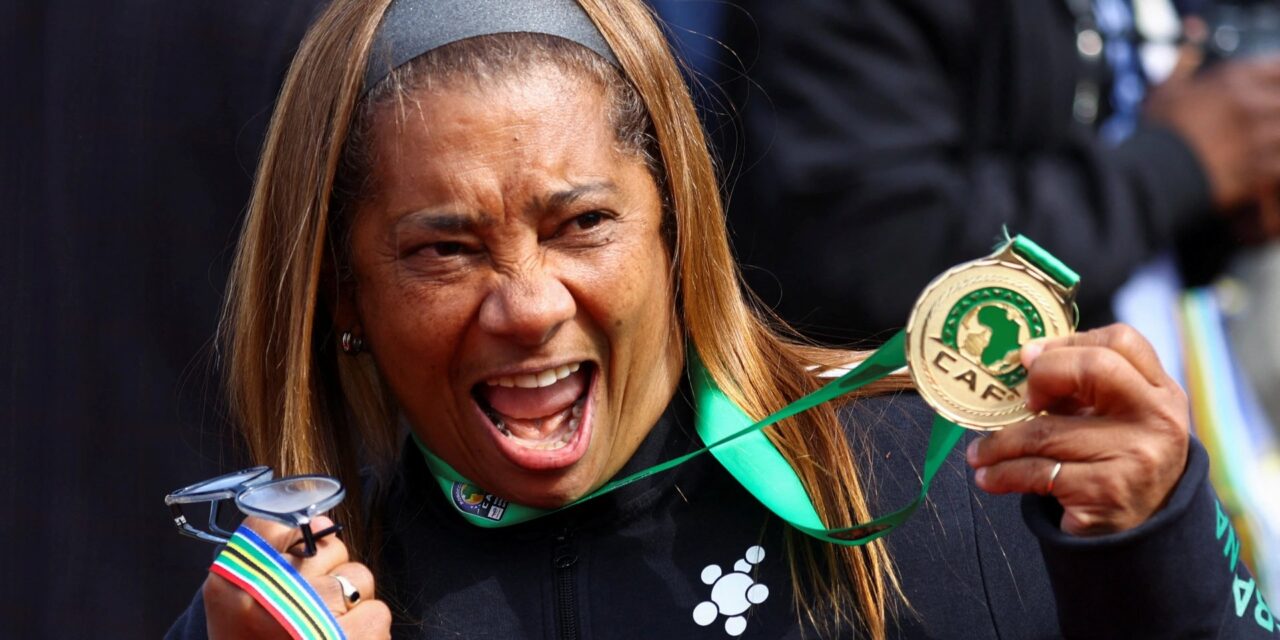
On Thursday night in Casablanca, 13 August, 2026, under the floodlights of the Moulay Rachid Stadium, Desiree Ellis stood on the touchline and watched her Banyana Banyana players do something no African side had ever managed against Nigeria’s Super Falcons quite so emphatically, quite so often, under quite so much pressure. A 2-1 win sealed by Thembi Kgatlana and captain Refiloe Jane sent South Africa through to the intercontinental play-offs for the 2027 FIFA Women’s World Cup in Brazil, ended Nigeria’s proud record of appearing at every Women’s World Cup since the tournament began in 1991, and delivered Ellis her 68th win from 137 matches in charge. It was, by any measure the ten-time African champions could offer, another chapter in a rivalry that Ellis — more than any coach who has ever paced a technical area on this continent — has made her own.
This being Women’s Month, it is worth pausing on the scoreline just long enough to ask a bigger question: who is the woman who keeps finding a way to beat Nigeria, keeps finding a way to make history, and keeps doing it all with the same quiet, unshakeable calm? The answer is a story that starts not in a dugout, but on the streets of Salt River, Cape Town, at a time when the little girl playing football there was breaking the law simply by doing so.
A girl from Salt River
Desiree Ellis was born and raised in Salt River, an economically deprived, racially mixed suburb of Cape Town, at the height of apartheid. Football for women was barely tolerated and, for a girl of colour, doubly discouraged — yet Ellis was incorrigible about the game from the start. She would famously jump the school fence to join the boys’ matches, collecting more than her share of trouble for it, and when no team would have her, she and her friends simply built one of their own, raising bus fare through fundraisers and wearing kit sewn by her mother, who worked at a local textile factory.
It would take fifteen years of persistence before that talent was allowed anywhere near a national jersey. Ellis was thirty years old — an age at which most footballers are contemplating retirement — when she finally pulled on a Banyana Banyana shirt for the very first time, in the team’s first-ever official international, a 14-0 demolition of Eswatini in 1993. She marked the occasion with a hat-trick. It was less a debut than a statement of intent.
She went on to captain the side for eight of her nine international years, earning 32 caps and leading South Africa to two Women’s Africa Cup of Nations finals — heartbreakingly, both lost to Nigeria. She retired in 2002 at 38, her playing career a testament to patience rewarded, but with the continental title that had eluded her as a player still, at that point, a dream deferred.
From Apprentice to Trailblazer
Ellis did not simply hang up her boots and disappear. She coached her former club side, worked through her badges, and in 2014 was brought in as assistant to Dutch coach Vera Pauw. When Pauw departed after the 2016 Olympics, Ellis was handed the reins on an interim basis — and never let go. She was confirmed as permanent head coach in February 2018, becoming both the first woman of colour and the first former Banyana player to lead the national team. It was a milestone layered on a milestone: a daughter of apartheid-era Salt River now running the country’s most successful women’s sporting institution.
What followed has redrawn the record books of African women’s football. Under Ellis, Banyana qualified for a first-ever FIFA Women’s World Cup in 2019. Three years later, in front of more than 50,000 fans in Rabat, she coached South Africa to a maiden WAFCON title in 2022, defeating hosts Morocco in the final and ending a run of four painful runner-up finishes stretching back to 2000 — finals in which, as a player, Ellis herself had twice fallen short. Then came 2023, and history of an entirely different order: Banyana became the first senior South African national team, men’s or women’s, to escape the group stage of a World Cup, beating Italy 3-2 in Wellington to reach the last 16.
The Nigeria Question – and why Thursday mattered so much
No fixture on the continent carries quite the psychological weight of South Africa versus Nigeria. For decades the Super Falcons were the immovable object standing between Banyana and glory — beating them in the 2018 WAFCON final on penalties, eliminating them from Paris 2024 Olympic qualifying, and knocking them out in the semi-finals of WAFCON 2024. Nigeria arrived in Casablanca this month having won the lion’s share of the sides’ head-to-head history.
And yet, under Desiree Ellis, that old order has quietly been rewritten. It was Ellis’s Banyana who beat Nigeria 4-2 in Lagos to win the 2021 Aisha Buhari Cup. It was Ellis’s Banyana who beat Nigeria in the final to lift that long-awaited 2022 WAFCON crown. And now it is Ellis’s Banyana who have beaten Nigeria again, on the biggest stage of all, with a World Cup place on the line. Three separate victories over the continent’s most storied women’s football nation, delivered by the same coach — a feat no other Banyana coach, and by most accounts no other coach on the continent, has managed against the Super Falcons. If South Africa’s women’s game has a rivalry to define it, Desiree Ellis has increasingly become the answer to it.
“It’s not a place we want to be, but we have been given another opportunity,” Ellis said in the build-up to Thursday’s match, of the play-off route Banyana were forced into after a quarter-final exit to hosts Morocco at WAFCON 2026. “It’s a very big opportunity to go on a very long journey, so we have to grab it with both hands.” Her players did exactly that — and Ellis, typically, turned the credit outward afterwards, praising a resilient, disciplined performance and a nerveless goalkeeping display from Player of the Match Kaylin Swart after Nigeria’s late penalty set up a nervous finish.
Dr Ellis: A Doctorate Earned, not Given
In April 2024, the Cape Peninsula University of Technology conferred Desiree Ellis with an Honorary Doctorate in Sports Management, recognising a body of work that stretches from playing pitch to press conference to podium. Accepting the honour in her home city, in front of family who had watched her build a career from nothing, an emotional Ellis dedicated the doctorate to everyone who believes in the power of sport to lift people out of their circumstances.
It sits alongside a mantelpiece that would make most sporting administrations blush: a record four CAF Women’s Coach of the Year awards, the Order of Ikhamanga in Gold from President Cyril Ramaphosa, and induction into the South African Hall of Fame alongside Bafana Bafana legends Neil Tovey and Lucas Radebe. For a woman who was fired from a job simply for playing football for her country in the 1990s, the title “Dr” in front of her name is not a formality. It is a full-circle moment, decades in the making.
The Road to Brazil – A Third World Cup Beckons
Beating Nigeria does not hand Banyana a ticket to Brazil outright. It earns them a place in a demanding, two-phase intercontinental play-off gauntlet running from November 2026 to February 2027. In the preliminary round, South Africa will be drawn into a six-team group against sides from Asia, South America and Oceania, each playing three matches, with only the top two advancing. Survive that, and a six-team knockout tournament in February decides the final three teams to book their place at the 2027 Women’s World Cup.
It is a long and unforgiving route — but if anyone has built a career on turning long, unforgiving routes into history, it is Desiree Ellis. Should Banyana navigate it successfully, it will be Ellis’s third World Cup as head coach, following the trailblazing qualification of 2019 and the round-of-16 heroics of 2023. Few coaches, anywhere in world football, arrive at a third World Cup campaign carrying the achievements Ellis already has behind her — and fewer still have done it while also carrying an entire nation’s women’s game on their shoulders.
There is a version of this story where the WAFCON quarter-final exit to Morocco is the headline, and the play-off route is treated as a consolation prize. Desiree Ellis has never read the story that way. She has spoken often about the value of adversity in forging her squad’s identity, and there is a real case that this extended campaign — international windows in November, December and February, more high-pressure knockout football against unfamiliar opposition — will only sharpen a Banyana squad that already knows how to find its very best football when the stakes are highest.
A Praise Song for Dr Ellis
In the oral traditions of Southern Africa, a great leader earns izibongo — praise poetry recited to honour deeds too large for ordinary conversation. Desiree Ellis has, in her own quiet and understated way, earned every line of one: the girl who was told the game wasn’t hers and made it her life’s work anyway; the captain who lost two finals to Nigeria and, as a coach, has now beaten them three times over; the trailblazer who turned Banyana Banyana from continental also-rans into WAFCON champions and World Cup knockout regulars; the pioneer who wears the title “Doctor” not for research papers but for a lifetime spent proving what South African women can achieve when given the chance.
As Banyana Banyana now wait to learn their opponents for the November/December preliminary play-off round, there is a nation of young girls watching Desiree Ellis and understanding, perhaps for the first time in South African sport, exactly what is possible for them too. Should the road to Brazil open up as it has so often opened up for her before, it will not be the first time Dr Desiree Ellis has taken her country somewhere it has never been. It will simply be the latest.
Whatever the draw brings, and however the next six months unfold, one thing is already settled: in the story of African women’s football, few names will be written larger, or more deservedly, than hers.
Dr Desiree Ellis — Banyana Banyana Head Coach, WAFCON 2022 Champion, four-time CAF Women’s Coach of the Year, and Honorary Doctor of the Cape Peninsula University of Technology
LEN KALANE is former City Press newspaper editor, author of The Chapter We Wrote – The City Press Story and now founder and publisher of publisher of PiE Digital Platform, a brand new initiative to create a commercial site designed by an all-South African and African cast. This story first appeared at www.piedigital.Africa.