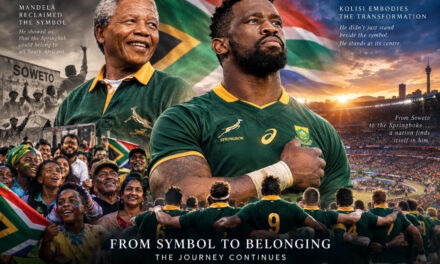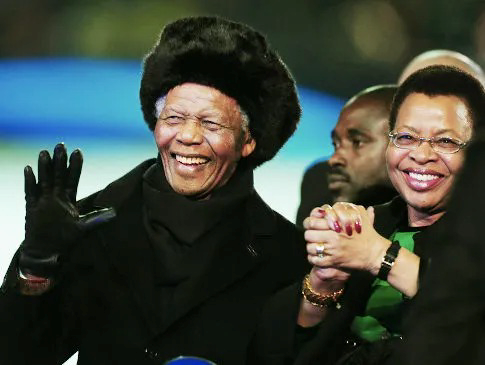
I write this article to mark Mandela Day (18 July) and hope my words reach you wherever you are in the heavens. In this month 16 years ago (on 11 July 2010) you and Mam Graca floated across the field in a golf cart at Soccer City in Johannesburg, the first World Cup final ever held on African soil. It was to be your last public appearance before your passing. You went home to watch Spain face the Netherlands in a tense, physical match, with both sides chasing their first world title after long histories of near-misses and heartbreak. After 90 goalless minutes, Spain finally broke through in extra time when Andrés Iniesta scored in the 116th minute, securing a 1–0 victory and Spain’s first World Cup crown.
How will I ever forget your warm fluffy Russian-like cap, your enchanting smile, your gracious wave with your gloved hand turning that final into more than a football match. How will I ever forget the thunderous applause that greeted you as the whole stadium rose acknowledging Africa’s place on the world stage. Already frail, your joyous presence symbolised our journey from apartheid to democracy and the celebration of our continent’s possibilities.
This Sunday (19 July, a day after we mark your birthday across the world), Spain will go up against Argentina in the World Cup final. The final will take place when our country and the continent stands on the cusp of undoing all the hard work of over a century. Find Nyeyere, Machel, Kaunda and other leaders from Southern Africa, confer with them and send us the energy to turn this unfortunate circumstance around. Read these words I send you below and help our people here and across the continent stay on the course that you and others mapped out for us. I know it depends on us but a little bit of help from all of you will be greatly appreciated.
With love,
Zubeida Jaffer
Cabo Verde’s first World Cup was a bold announcement that this small island nation belongs on football’s biggest stage. With a population of about 530,000, their presence was itself a story of overachievement. Cabo Verde is an Atlantic archipelago several hundred kilometres west of Senegal, with its capital in Praia on Santiago Island.
The Blue Sharks drew with Spain in the group phase, proving they could compete with one of the game’s traditional powers while playing with courage and ambition. They went on to reach the knockout rounds on debut, becoming the smallest country ever to do so, and earned a tie against defending champions Argentina. Goalkeeper Vozinha embodied their spirit with standout saves and leadership, helping turn Cabo Verde’s campaign into a source of continental pride.
What a single drop in the Atlantic Ocean could achieve.
Cabo Verde’s run fits into a wider picture: this World Cup with all its imperfections featured a record number of African qualifiers, and multiple African sides advanced to the knockout rounds, reinforcing a pattern of improved performance on the global stage. Morocco’s deep run in recent tournaments and Senegal’s persistent competitiveness are further evidence that the competitive gap with traditional powers is narrowing. South Africa’s Bafana Bafana reaching the round of 32 for the first time in the country’s history deepens that sense of possibility. They broke their long‑standing “group-stage ceiling” and officially finishing joint 25th out of 48 teams.
Sporting progress sits alongside demographic and geopolitical shifts that could reshape the continent’s influence. United Nations projections indicate Africa’s population will grow substantially over the coming decades. South African business leader Phuthuma Nhleko, in his book, The Invisible People, published recently, asserts that by 2050 Africa’s population will double in size to 2.5 billion. One in four people on earth will be African. He lays out three pillars to help Africa translate demographic weight into development and influence: building a confident continental identity, adopting new economic strategies that leverage Africa’s assets and technological opportunities, and redefining relationships with major powers to prioritize African interests.
Yet these hopeful signs coexist with troubling social fractures. South Africa has seen waves of xenophobic violence in recent years, attacks that scholars and journalists have linked to economic stress, political opportunism, and local social tensions. Those incidents undermine regional solidarity precisely when cooperation is most needed. If leaders and citizens allow scapegoating to take root, the moral and political capital generated by sporting and social achievements risks dissipating before it can translate into lasting progress.
Sport can be a catalyst for broader change, but the pathway from the pitch to policy must be made explicit. Sporting success creates attention, national pride, and soft power; these can be converted into concrete gains through sustained investment in youth development, regional cooperation (for example through SADC and AU initiatives), diaspora engagement, and robust anti‑discrimination measures. Absent institutional follow‑through, the goodwill of a tournament fades into memory.
Back to Cabo Verde. Perhaps its World Cup performance should not be dismissed as a mere drop in the ocean. As the Persian poet Rumi wrote, it is “the entire ocean in a drop” — a reminder that one team’s achievement can embody a continent’s spirit and potential. But to turn that symbolic moment into enduring change requires deliberate choices by leaders and citizens alike: protect vulnerable communities from violence, invest in people and institutions, and use moments of shared pride to build inclusive, long‑term agendas.
Southern Africa especially is being drawn into a battle against itself exactly when the greatest historical requirement is to cement in place an unmoveable unity. Those who have lit the fire will happily laugh out loud when the next SADC Summit of heads of State and Government meets in Durban on 16-17 August 2026. They will laugh as South Africa takes over its one-year-term as Chair of SADC if member countries are unable to show what unity means against this backdrop of fear and anger dripping into the body politic. How shameful it is that there are South Africans that run into people’s home and drag them out because they suspect them to be Malawian or Zimbabwean.
It is up to governments and people in Southern Africa to transform the emotional solidarity of World Cup time into everyday commitments to justice, inclusion, and regional cooperation. And to do this against a backdrop of implementing administrative systems that manage immigration policy fairly. Only then will the drop become part of an enduring tide of African progress — one strong enough to reshape both the game and the world beyond.
P.S. As I load this article, news has come through that 31 organisations in Cape Town have met and called on us to march to Parliament on Saturday August 8, 2026. The march will reassert your values of ubuntu and African unity. (read at https://muslimviews.co.za/mass-march-to-parliament-planned-to-combat-xenophobia-and-afrophobia/)
Pic Courtesy of Getty Images
This article first appeared at www.zubeidajaffer.co.za.